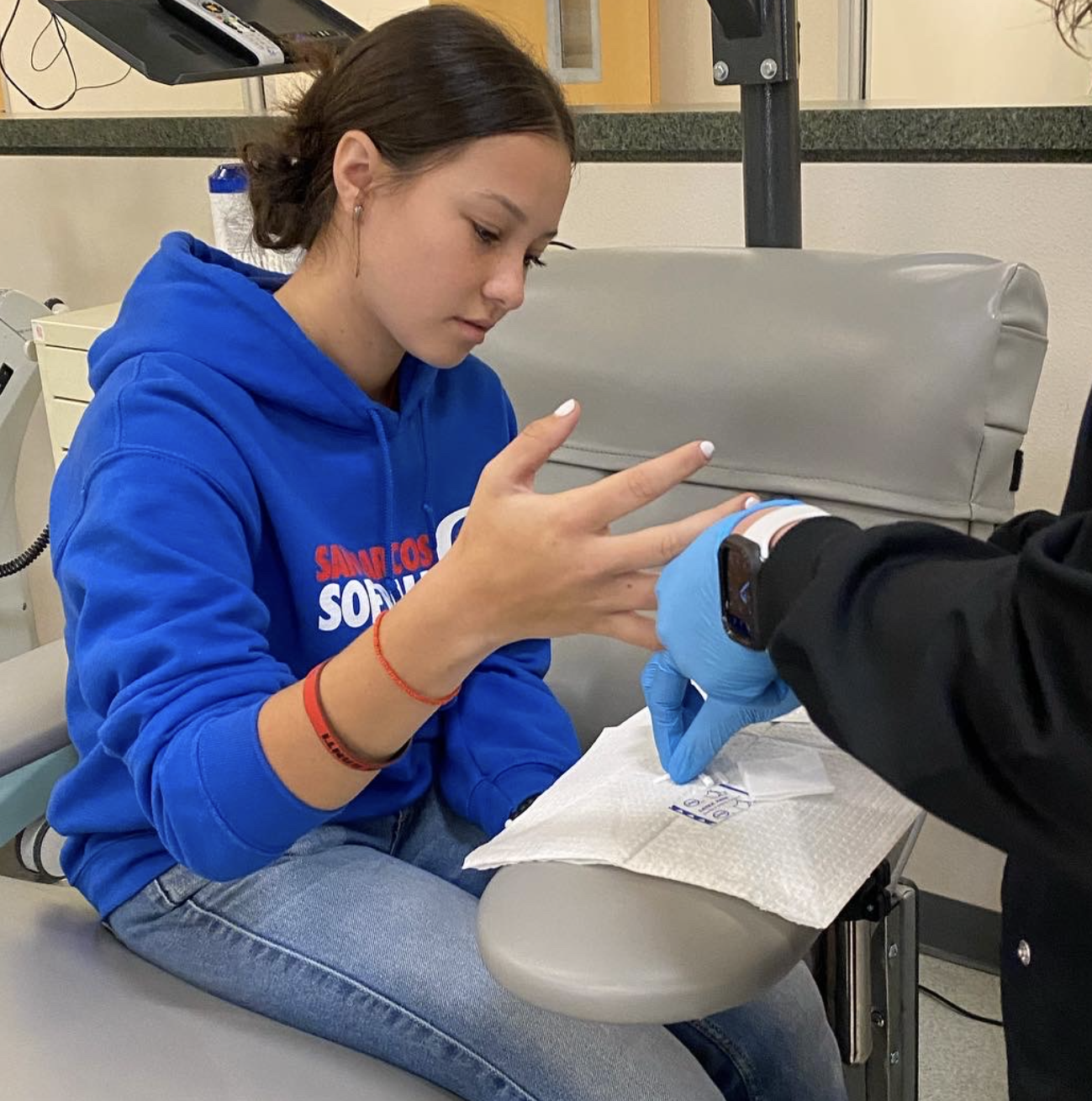
The Cottage Health Careers Academy (CHCA) has officially expanded and is integrating various changes to the pathway curriculum and experiences. In Fall 2026, Project Lead The Way (PLTW) Biomedical Science and Mental Health and Wellness curriculum were added, and historic courses are sunsetting as new courses are implemented. This expansion has allowed CHCA students to begin the academy experience freshman year, and earn hands-on learning experiences through partnerships with organizations like PLTW, Cottage Health, and Santa Barbara City College.
-
Required Senior Year Course:
Kinesiology
Optional Senior Year Courses:
Certified Nursing Assistant through Santa Barbara City College (only available to 15 seniors via application/lottery system)
CHCA in Action (internships)
-
Required Junior Year Course:
Allied Health Careers
Required Senior Year Course:
Kinesiology
Optional Junior-Senior Year Courses:
Honors Medical Biology
Certified Nursing Assistant through Santa Barbara City College (students will apply Spring 2027 via SBCC application and will be selected via lottery, only available senior year to 15 students)
CHCA in Action (internships, senior year only)
-
Required Sophomore Year Course:
Honors Principles of Biomedical Science
Required Junior Year Course:
Honors Human Body Systems
Required Senior Year Course:
Honors Medical Interventions
Required Sophomore-Senior Year Course:
Mental & Behavioral Health Essentials (taken once anytime during four years)
OPTIONAL Sophomore-Senior Year Courses:
Honors Medical Biology
Certified Nursing Assistant through Santa Barbara City College (senior year only)
CHCA in Action (internships, senior year only)
Sports Medicine
AP Psychology
-
Required Freshman Year Course:
Honors Principles of Biomedical Science
Required Sophomore Year Course:
Honors Human Body Systems
Required Junior Year Course:
Honors Medical Interventions
Required Senior Year Course:
Honors Biomedical Innovations
Required Freshman-Senior Year Course:
Mental & Behavioral Health Essentials (taken once anytime during four years)
OPTIONAL Freshman-Senior Year Courses:
Honors Medical Biology
Certified Nursing Assistant through Santa Barbara City College (senior year only)
CHCA in Action (internships, senior year only)
Sports Medicine
AP Psychology
-
Required Freshman Year Course:
Honors Principles of Biomedical Science
Required Sophomore Year Course:
Honors Human Body Systems
Required Junior Year Course:
Honors Medical Interventions
Required Senior Year Course:
Honors Biomedical Innovations
Required Freshman-Senior Year Course:
Mental & Behavioral Health Essentials (taken once anytime during four years)
OPTIONAL Freshman-Senior Year Courses:
Honors Medical Biology
Certified Nursing Assistant through Santa Barbara City College (senior year only)
CHCA in Action (internships, senior year only)
Sports Medicine
AP Psychology
and more to come!
Course Overviews
Project Lead The Way (PLTW) Biomedical Science Courses: The Cottage Health Careers Academy is implementing the nationally recognized Project Lead The Way (PLTW) Biomedical Science curriculum which is a rigorous, four-year sequence designed to prepare students for careers across the full spectrum of healthcare and biomedical fields. Each course builds on the skills and knowledge students gain in the preceding courses, creating a cohesive pathway from foundational concepts all the way to original innovation.
Students build their knowledge in biomedical science, confidence in their capacity to tackle difficult problems, and the ability to effectively communicate and collaborate with their peers. Rather than traditional lecture-based learning, every course uses an Activity-Project-Problem approach meaning students learn by doing, investigating, and solving real healthcare challenges.

Mental & Behavioral Health Essentials: This wellness-focused course offered to CHCA students teaches them how to develop self-awareness, apply evidence-based wellness strategies, explore lived experiences, and learn how to advocate for mental health in their school and community.
Through journaling, peer-reviewed research, project-based learning, guest speakers, book clubs, and outdoor immersion experiences in partnership with the Wilderness Youth Project, students engage with mental health not just as an academic subject but as a lived practice.
This course prepares students to understand the science of mental health, recognize warning signs in themselves and others, and enter healthcare careers with both the knowledge and compassion that the field demands.

Kinesiology: This course is designed to offer a 4th year of science credit for the students in the Health Careers Academy. Students will receive core classroom instruction in kinesiology, biomechanics, anatomy, physiology, health processes, injury evaluation, and basic knowledge of sports medicine, personal training, physical therapy and fitness instructor. In addition, students will take part in labs in the classroom that will enable them to use a hand on approach to understanding lecture materials.
Honors Medical Biology: This is a course in basic biology with medical application for college preparatory students. The laboratory-oriented course will cover concepts in basic biochemistry, cells, cellular energy, genetics, human biology, evolution, and ecology all with an emphasis on health and medicine meeting all the California state biology standards. This course will meet the Life Science graduation requirement.
CHCA in Action: Students are placed in an internship opportunity for one semester during their senior year. The goal of the internship experience is to enhance the student's knowledge of a particular medical field or profession. By participating in the internship, the student will obtain a perspective of the skills and tasks that are required of this particular job. As a result of this experience the student will better understand what kind of training and education they will need in the future. This experience allows the student to understand the connection between schoolwork and their future career. Sites vary according to the student's interest and space availability.
Allied Health Careers: This course will focus on the concepts and principles of the structure, function, and systems of the human body in relationship to human growth and development. Students will learn to recognize problem situations in health care settings as they relate to direct and indirect patient care. Safety issues, ethical considerations, legal constraints and professional codes will be presented and discussed throughout the course. An extensive unit on HIPAA requirements will be taught. Students will use the knowledge of disease prevention for the maintenance of optimal health. Students will learn foundation skills and be certified in CPR and First Aid. In addition, students will be exposed to guest speakers from various health care fields.
Sports Medicine: This course is designed to help students develop an awareness of health careers within the physical therapy and sport medicine occupations. Classroom instruction covers such topics as: medical terminology; human anatomy; emergency procedure; soft tissue and bone injuries; causes, symptoms, and management of injuries; nutrition; physical fitness; and career opportunities. In addition to the classroom instruction, students will rotate through on-the-job training experiences with local physical therapists, chiropractors, athletic trainers, and physical education teachers.
AP Psychology: This course introduces students to the systematic study of human behavior and mental processes. While considering the psychologists and studies that have shaped the field, students explore and apply psychological theories, key concepts, and phenomena associated with such topics as the biological bases of behavior, sensation and perception, learning and cognition, motivation, developmental psychology, testing and individual differences, treatment of abnormal behavior,and social psychology. Throughout the course, students employ psychological research methods, including ethical considerations, as they use the scientific method, analyze bias, evaluate claims and evidence, and effectively communicate ideas.